The Selvaggio Blu Trek: What It Demands, and Who Should Not Attempt It
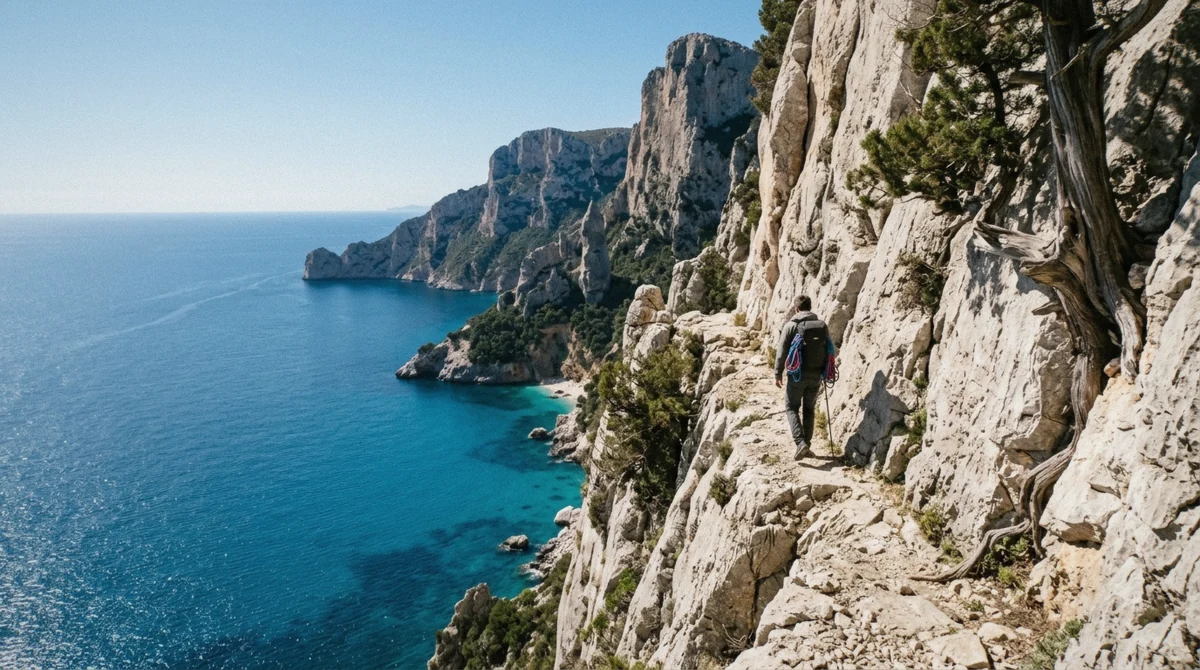
The Selvaggio Blu gets called Italy's hardest trek so often that the phrase has stopped meaning anything to most readers. It should mean something specific here: unmarked coastal terrain above the Gulf of Orosei, old juniper-log walkways over drops of hundreds of metres, at least one abseil, and a water problem that has no easy fix. This guide to the Selvaggio Blu trek sets out plainly what the route actually asks of you, the Comune di Baunei's registration rules, and the single-day walks on this site that give a real taste of the same coastline without the risk.
Quick answer
The Selvaggio Blu is an unmarked coastal traverse in the Baunei municipality, roughly 40 km from Pedra Longa to Cala Sisine, with abseils, exposed ledges and old juniper-log walkways. No law requires a guide, but the Comune di Baunei's ordinance requires advance registration, a €30 per-person fee, and caps groups at 10 participants plus one guide, and the lack of waymarking is why nearly every party goes guided anyway.
Key takeaways
- Registration with the Comune di Baunei is mandatory: €30 per person, groups capped at 10 plus one guide
- Guided crossings run roughly €700 to €1,230 per person and take six to seven days including logistics
- There is no reliable water on the route; it is pre-placed by guides or dropped by boat and even that is not fully reliable
- For a real taste of this coastline in a single day, the Cala Coticcio hike on Caprera at $68 (about €59) walks similarly exposed granite terrain with a guide and no overnight risk
- Best season: spring and autumn, roughly March to June and September to October
- None of the walking days we list crosses the Selvaggio Blu itself; see the easier guided hikes across Sardinia for what fits most visitors instead
What the Route Actually Is
The Selvaggio Blu runs along the coast of the Baunei municipality, from Pedra Longa to Cala Sisine, with some route variants finishing instead at Cala Luna. It is commonly described as about 40 km with roughly 4,400 m of cumulative ascent and descent, though operator descriptions run up to 50 km depending on the exact variant walked, so treat the elevation figure as depending on which line a given guide takes rather than a single fixed number.
The classic description breaks the route into four stages, and guided crossings usually run six to seven days once approach hikes and logistics are included. None of the tours sold on this site is the Selvaggio Blu itself; this page exists to answer the question honestly and to point readers who want the coastline, but not the full commitment, to the single-day guided walks that cover similar ground.
The Rules: Registration, Fee and Bivouac Ban
The Comune di Baunei's 2019 ordinance is the governing framework for anyone walking this route, guided or not. Last verified: August 2026.
| Rule | Detail |
|---|---|
| Registration | Mandatory in advance with the Comune di Baunei, naming your departure date, route and any bivouac site |
| Fee | €30 per person |
| Group size | Capped at 10 participants plus one guide |
| Bivouac | Free camping and bivouacking outside approved sites is prohibited across the municipal territory |
| Guide requirement for some bivouac sites | A number of the approved bivouac sites may only be used by parties accompanied by a qualified alpine or environmental guide |
No law obliges an individual hiker to hire a guide for the Selvaggio Blu itself, but the registration and bivouac rules, the near-total lack of waymarking, the abseils, and the water problem below are, together, why nearly every party that walks it goes with a professional outfit rather than alone.
Is the Selvaggio Blu Worth Attempting?
What we genuinely like
- A coastline with almost no other visitors, walked the way it was first explored rather than along a maintained path
- Terrain and views genuinely unlike anything else reachable on foot in Sardinia
- A real multi-day wilderness experience within a Mediterranean island most visitors treat as a beach destination
The honest downsides
- Unmarked for most of its length, with real navigation demanded of the group leader
- Exposed ledges hundreds of metres above the sea and short rock steps graded around IV on the UIAA scale
- No reliable water source anywhere on the route
- A six-to-seven-day commitment and a cost, guided, that runs into four figures per person
Who it's NOT for: Anyone without prior multi-day trekking experience, anyone uncomfortable with exposure or an abseil, and anyone who cannot commit to a guided crossing's water-carrying and bivouac logistics should not attempt this route independently, and should think carefully before attempting it at all.
The Technical Demands, Stated Plainly
This is the one point in this guide where softening the language would be dishonest. The Selvaggio Blu is unmarked for most of its length, with only a little blue paint appearing near the end of the route. Much of the walking happens on exposed ledges hundreds of metres above the sea, connected in places by old juniper-log walkways and fixed ropes.
At least one stage involves an abseil, and short rock steps are graded around IV on the UIAA scale, which is genuine scrambling and climbing movement, not hiking. None of this is described here to discourage a genuinely prepared party; it is described plainly because a reader deciding whether to attempt this route deserves the same information a guide would give them before agreeing to take them on.
Sources disagree on exactly how many abseils the route involves and how long each one is, because several route variants exist and guided operators do not all take the same line. The honest statement is that the number and length of the abseils depends on the variant your group walks, not a fixed figure this guide can hand you. No accident or rescue statistic for this specific route could be verified for this guide, and none is printed here; treat the absence of a public figure as a reason for caution, not reassurance.
Water, the Defining Problem
There are no reliable springs anywhere on the Selvaggio Blu. Water is pre-placed in containers by guides ahead of a crossing, or dropped by boat at points along the coast, and even that system is described by operators as not fully reliable. Independent parties attempting the route have to carry their own water or arrange their own caching, in terrain where every extra litre is real weight on already technical ground.
This single fact, more than the abseils or the exposure, is why the route resists a true do-it-yourself approach. A navigation mistake can be corrected. A water shortfall four days into an unmarked coastal traverse with no easy exit cannot be corrected quickly, which is the practical reason guided logistics dominate this route even for very experienced independent hikers.
One practical detail that belongs with the water planning: there is no mobile coverage on long stretches of the route, and the emergency number across Italy is 112. Ask for mountain rescue and say where you started that morning, because on this coastline the difference between a two-hour and a ten-hour response is whether the team knows which stage you are on.
What a Guided Crossing Costs and Includes
A guided crossing of the Selvaggio Blu typically runs roughly €700 to €1,230 per person, depending on the operator and the exact length of the itinerary, with full logistics included: route-finding, rope work on the technical sections, water placement, and camp organisation across the six to seven days. Last verified: August 2026. The Comune di Baunei's €30 registration fee sits on top of whatever an operator charges and is not included in that range.
That price reflects genuine infrastructure, not markup for its own sake: a qualified guide certified for technical coastal terrain, the logistics of getting water to remote points by boat or on foot ahead of the group, and the small group size the municipal ordinance itself requires. Set against a week of guided hiking elsewhere on the island, it is a different category of trip entirely, closer to an expedition than a day tour.
| What | Handled by a guided crossing | Left to an independent party |
|---|---|---|
| Route-finding on unmarked terrain | Yes, the guide leads the line | You navigate the whole route yourself |
| Water | Pre-placed or boat-dropped ahead of the group | You carry or arrange your own caching |
| Rope work on the abseil stage | Set and managed by a certified guide | You need your own gear and rope skills |
| Registration with the Comune di Baunei | Most operators arrange it; the €30 fee is still separate | You register directly yourself |
| Bivouac sites | Booked within the approved network | You must confirm which sites you're permitted to use |
What to Prepare Before You Go
None of this is a casual add-on packing list. Every item below exists because of a specific rule or hazard on the Selvaggio Blu, from the Baunei registration requirement to the water problem.
- Registration confirmation from the Comune di Baunei, saved offline, naming your dates and route
- Proof the €30 per-person fee has been paid
- A confirmed water plan with your guide for every stage, not an assumption that springs exist
- Rope and abseil equipment appropriate to the technical stage, checked and fitted before departure
- Sturdy, broken-in boots with real ankle support, not trail runners
- A multi-day pack with a rain layer, since coastal weather can turn quickly even in the recommended seasons
- Travel insurance that explicitly covers technical trekking and rope-assisted terrain, not a standard policy
- A realistic fitness base of multi-day trekking experience before you commit to six or seven consecutive days
- Italy's emergency number, 112, saved and known even where phone coverage is patchy along the coast
Season, Heat and Fire Risk
The Selvaggio Blu is best walked in spring and autumn, roughly March to June and September to October, when temperatures on exposed coastal rock are survivable and the water problem is at its least acute. Summer on this coastline is a different proposition: Sardinia's regional fire-danger season runs from 1 June to 31 October under the region's 2026 to 2028 anti-fire plan, and the numbers from July 2026 make the case on their own, with 47.8°C recorded at Uta Santa Lucia and 75 per cent of the region's weather stations passing 40°C over a four-day stretch.
None of that makes the Selvaggio Blu unwalkable in summer by rule, since there is no standing regulation that a given fire-danger level automatically closes the trail. It makes it a genuinely poor decision on exposed, shadeless coastal rock with an already unreliable water supply. Guided operators schedule around this for a reason.
The Single-Day Walks That Scratch the Same Itch
If you want exposed coastal terrain and real views without a multi-day commitment
book the Cala Coticcio hike on Caprera. It walks similarly rugged granite coastline with a certified guide in a single day.
If you want the Supramonte limestone landscape the Selvaggio Blu sits within, inland rather than at the coast
walk Gola su Gorropu, a full technical canyon day with none of the multi-day logistics.
If you want the closest single-day approach to the actual Gulf of Orosei coastline
read our guide to the Gulf of Orosei's other coastal hikes, several of which are genuinely reachable on a day trip.
If you have real multi-day trekking experience and want to attempt the Selvaggio Blu itself
register with the Comune di Baunei well ahead and book a guided outfit; do not attempt the technical stages solo without one.
If you're still deciding between the island's trails generally
start with Sardinia's best hiking trails for the full comparison by difficulty.
Guided Hikes on This Site
None of these is the Selvaggio Blu. Each one walks a real piece of the same coastal or Supramonte landscape, guided, in a single day.
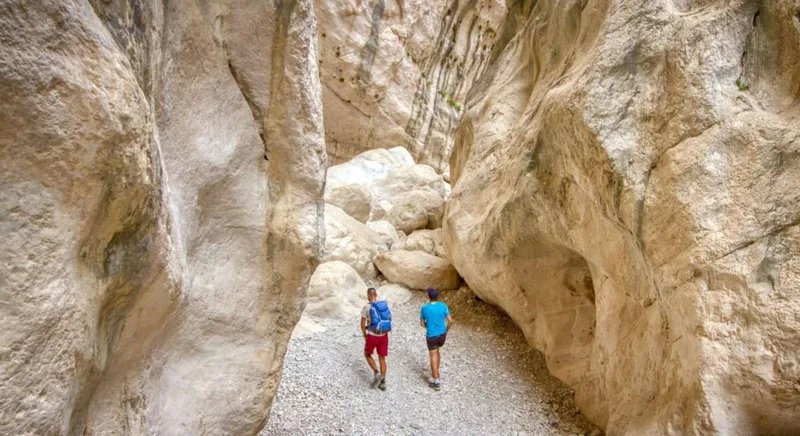 from $74
From Orosei or Dorgali: Gorropu Canyon Guided Hike
Hike into the breathtaking Gorropu canyon across the wilderness of the Supramonte — one of the finest treks in Sardinia. With convenient hotel transfers from Orosei or Dorgali…
- Hike into Gorropu — Europe's deepest canyon
- Hotel transfers from Orosei or Dorgali included
- Trek through the wild Supramonte along the Flumineddu riverbed
- Led by an expert local mountain guide
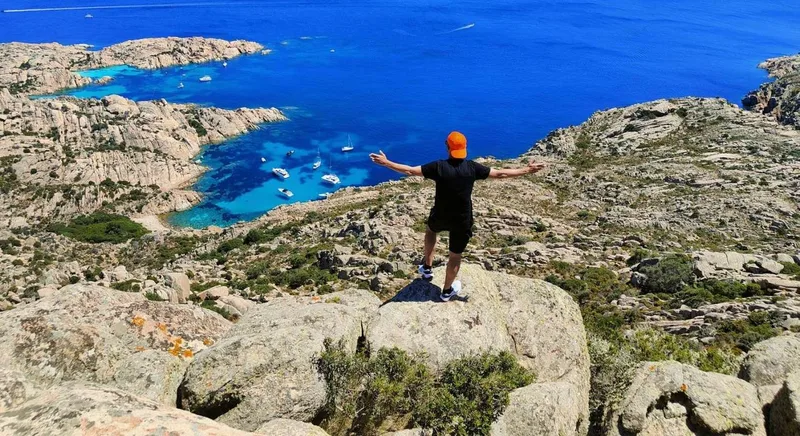 from $68
Trekking La Maddalena Archipelago — Caprera Island Hike to Cala Coticcio
The main trekking route in the La Maddalena Archipelago — hike through the pinkish granite landscapes of Caprera Island with a licensed National Park guide to reach Cala…
- La Maddalena Archipelago National Park — daily visitor numbers strictly limited
- Departs from La Maddalena area — Caprera Island via the causeway
- Snorkel in crystal-blue waters at Cala Coticcio — Sardinia's 'Tahiti'
- Park entrance ticket + Sardinian aperitif included
 from $122
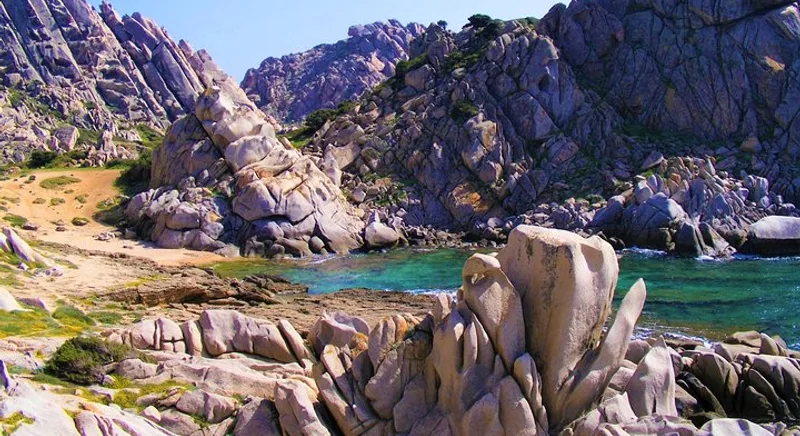
Capo Testa & Moon Valley Coastal Hike from Santa Teresa Gallura
Walk with expert guides through the wind-sculpted granite formations of Capo Testa on Sardinia's far northern tip, overlooking Corsica. Marvel at the lunar landscape of Moon Valley (Valle…
- Hike the wind-sculpted granite of Capo Testa overlooking Corsica
- Explore Moon Valley (Valle della Luna) — Sardinia's iconic lunar landscape
- Beach stop and free time in pretty Santa Teresa di Gallura
- Small group (max 8) with hotel pickup, lunch & AC vehicle
Frequently Asked Questions
Do you need a guide for the Selvaggio Blu?
No law requires one, but the lack of waymarking, the abseils, the technical rock steps and the unreliable water supply mean nearly every party that completes the route goes with a certified guide.
How difficult is the Selvaggio Blu?
It is unmarked for most of its length, with exposed ledges hundreds of metres above the sea, old juniper-log walkways, fixed ropes, at least one abseil, and short rock steps graded around IV on the UIAA scale. This is technical coastal trekking, not a hiking trail.
How much does the Selvaggio Blu cost?
A guided crossing typically runs roughly €700 to €1,230 per person depending on the operator and itinerary length, plus the Comune di Baunei's €30 per-person registration fee on top.
How many days does the Selvaggio Blu take?
The classic description breaks the route into four stages, and guided crossings usually run six to seven days once approach hikes and logistics are included.
When is the best time to walk the Selvaggio Blu?
Spring and autumn, roughly March to June and September to October. Summer brings extreme heat to this exposed coastline and worsens an already unreliable water supply.
Where do you get water on the Selvaggio Blu?
There are no reliable springs on the route. Water is pre-placed in containers by guides or dropped by boat, and even that system is described as not fully reliable, so independent parties must carry or cache their own.
Is there an easier way to see this coastline?
Yes. The Cala Coticcio hike on Caprera and the walks covered in our Gulf of Orosei coastal hikes guide reach genuinely similar terrain in a single guided day, with none of the Selvaggio Blu's multi-day risk.